







How Activated Charcoal Is Made: From Raw Material to Ultra-Porous Powerhouse

Activated charcoal (also called activated carbon) is one of the most fascinating materials in modern filtration and grooming science. Despite its simple appearance, it undergoes an intense, highly controlled manufacturing process that transforms ordinary organic material into a microscopic adsorption machine.
This in-depth guide walks through exactly how activated charcoal is made.
What Activated Charcoal Actually Is
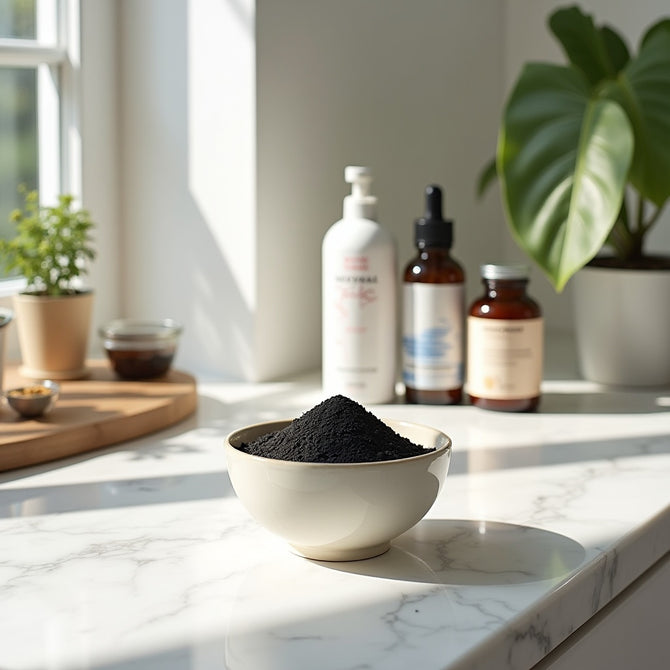
Activated charcoal is a form of carbon processed to develop millions of tiny pores, dramatically increasing its surface area. This massive internal surface allows it to trap and bind impurities through adsorption (molecules sticking to a surface).
To put it in perspective: one gram can have thousands of square meters of surface area.
But achieving this structure requires a precise manufacturing sequence.
Step 1: Selecting the Raw Material
Everything begins with a carbon-rich source material. Common feedstocks include:
• Coconut shells
• Wood
• Coal
• Peat
• Agricultural byproducts
The choice matters because it influences:
• Final pore size
• Hardness
• Adsorption performance
• Intended application
For example, coconut shell carbon tends to produce very fine micropores, making it popular in air and water purification.
Step 2: Carbonization (Making Char)
The goal is to convert the raw organic material into nearly pure carbon. The raw material is heated in a low-oxygen environment through a process called pyrolysis or carbonization.
Typical conditions:
Temperature: ~400–700 °C (often around 600 °C)
Oxygen: extremely limited
Equipment: kilns, retorts, or rotary furnaces
During this stage:
• Moisture evaporates
• Volatile compounds burn off
• Organic structure breaks down
• A basic carbon skeleton (char) forms
This step creates ordinary charcoal but it is not yet activated.
Carbonization essentially builds the framework that will later be carved into a porous network.
Step 3: Activation (The Critical Transformation)
This is the defining step that turns plain charcoal into activated charcoal.
The purpose of activation is to open and expand millions of microscopic pores within the carbon structure.
There are two primary industrial methods:
Method A: Physical (Steam) Activation
This is one of the most widely used processes.
The carbonized material is heated again at very high temperatures while exposed to oxidizing gases such as:
• Steam
• Carbon dioxide
• Controlled air
Typical conditions:
Temperature: 800–1100 °C
Atmosphere: controlled oxidizing gas
Equipment: rotary kilns or multi-hearth furnaces
At these extreme temperatures:
• Steam reacts with carbon
• Portions of carbon atoms are removed
• Tiny pores form and widen
• Internal surface area explodes
The reaction literally etches the carbon from the inside out, creating the sponge-like structure activated charcoal is known for.
Steam activation in rotary kilns typically takes about 25–40 minutes depending on conditions.
Method B: Chemical Activation
This method is often used for wood-based activated carbon and can be more energy efficient.
Raw material is impregnated with an activating chemical such as:
• Phosphoric acid
• Potassium hydroxide
• Zinc chloride
The mixture is heated to lower temperatures (often 400–800 °C).
The chemical agent:
• Dehydrates the material
• Prevents tar formation
• Promotes pore development
After heating, the carbon is thoroughly washed to remove residual chemicals.
Chemical activation can sometimes combine carbonization and activation into one step, improving efficiency.
Step 4: Cooling and Stabilization
Once activation is complete, the material is extremely hot and reactive.
Manufacturers rapidly cool it to:
• Stop further reactions
• Preserve pore structure
• Prevent combustion
Cooling systems may include:
• Water-jacket screw conveyors
• Cooling kilns
• Heat exchangers
Proper cooling is essential to maintain product quality.
Step 5: Washing and Purification
Especially after chemical activation, the carbon must be cleaned.
This stage may involve:
• Water washing
• Acid washing
• Alkali treatment
• Multiple filtration stages
The goal is to remove:
• Residual chemicals
• Ash
• Soluble impurities
Only after thorough washing does the material become safe for consumer and industrial use.
Step 6: Drying
Next, the washed carbon is dried to remove moisture.
Typical methods:
• Rotary dryers
• Oven drying
• Fluidized bed dryers
Drying ensures:
• Stable shelf life
• Accurate weight
• Consistent performance
Step 7: Sizing and Finishing
Activated charcoal rarely leaves the factory in large chunks.
Instead, it is processed into specific forms depending on its final application.
Common Forms
Powdered Activated Carbon (PAC)
• Very fine powder
• Used in cosmetics and water treatment
Granular Activated Carbon (GAC)
• Larger particles
• Used in filters
Pelletized Activated Carbon
• Cylindrical pellets
• Used in air purification systems
Manufacturers use crushing, milling, sieving, and briquetting to achieve the desired particle size and shape.
Step 8: Quality Testing
Before packaging, activated charcoal undergoes rigorous testing, often measuring:
• Surface area (BET analysis)
• Iodine number
• Ash content
• Moisture level
• Pore size distribution
These metrics determine whether the carbon is suitable for specific applications like water filtration, air purification, or personal care.
Why the Process Matters
The exact manufacturing conditions dramatically affect performance. Key variables include:
• Raw material type
• Activation temperature
• Reaction time
• Gas composition
• Chemical agents used
Even small changes can alter:
• Adsorption strength
• Pore size
• Product hardness
• Color and purity
That’s why high-quality activated charcoal is the result of precision engineering, not just burning wood.
Final Thoughts
Activated charcoal may look simple, but its production is a sophisticated, multi-stage process involving controlled heating, chemical reactions, and precision finishing.
In summary, activated charcoal is made by:
• Selecting carbon-rich raw materials
• Carbonizing them into char
• Activating the char with steam or chemicals
• Cooling and washing
• Drying and sizing
• Testing and packaging
The result is one of the most powerful natural adsorbents known, a microscopic filtration powerhouse that continues to play a major role in grooming, health, and environmental purification.


